Software Career Paths Part 1: Traditional Software Development
Stop the confusion. Understand the multiple paths. Make an informed choice.
Why Are Students So Confused? 🤔
You're scrolling through YouTube, and everyone says something different:
- "Learn Python, that's the future!"
- "AI jobs are everywhere now"
- "Go for Data Engineering, it's trending"
- "Java and .NET developers still earn well"
- "ERP jobs are stable and secure"
- "AI will replace all coding jobs soon"
You feel lost. You want to start your career on the right path, but everyone seems to have a different answer. Here's the truth: they're all right, and they're all incomplete.
The Real Truth 💡
The software industry isn't one path. It's a forest with many trails. Each trail leads somewhere different, and each is equally valuable.
The problem is that trending topics get all the attention. Everyone talks about AI. Few talk about the traditional developers who build the applications that AI runs on. Even fewer talk about data engineers who prepare the data that AI learns from. And almost nobody talks about ERP systems where some of the best-paying, most stable jobs exist.
What You ACTUALLY Need to Know 📚
Before choosing any career path, understand this fundamental truth:
There Are At Least 10 Different Software Career Paths
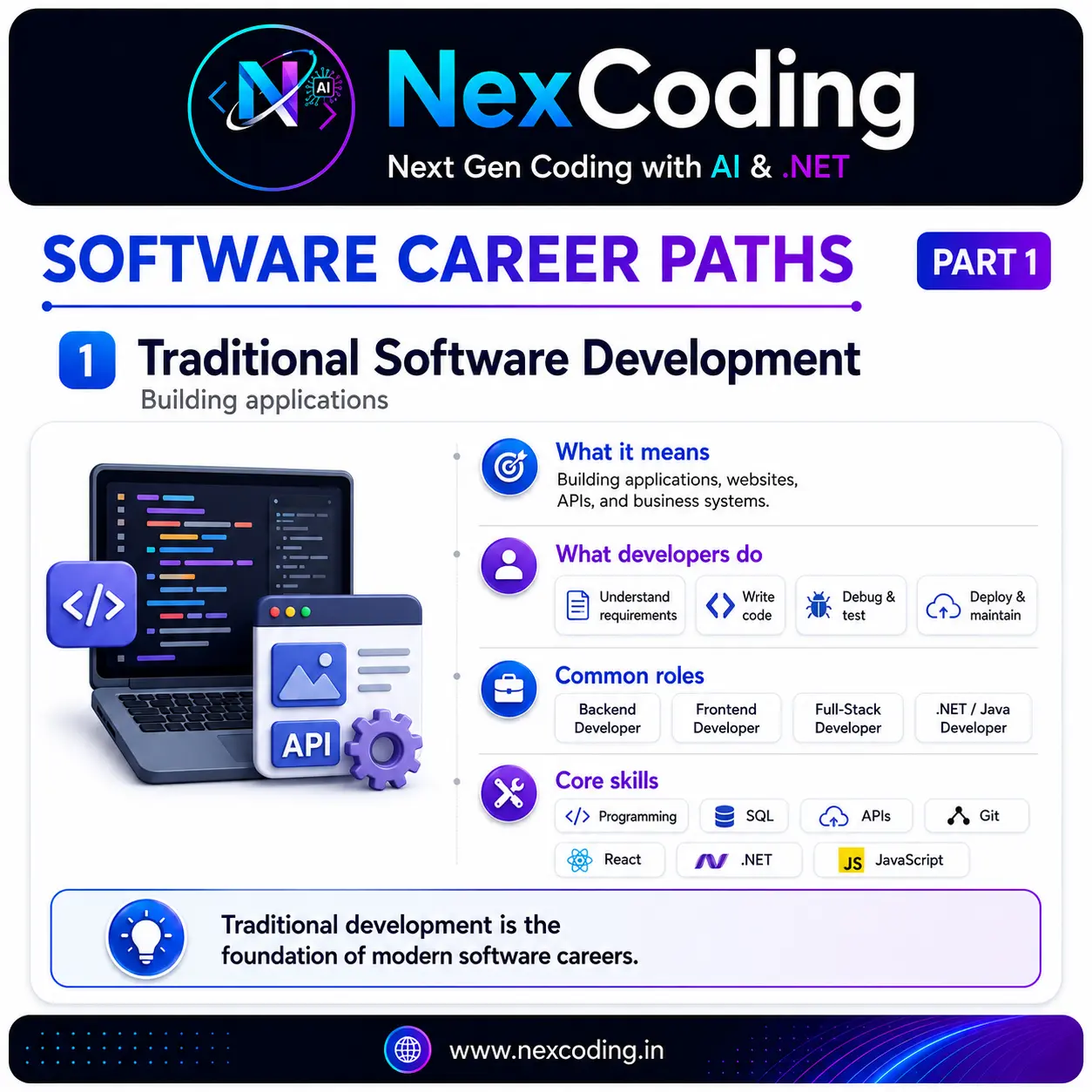
- Traditional Software Development - Building applications, websites, and systems
- AI & Machine Learning - Creating intelligent features and systems
- Data Engineering - Managing and preparing data
- Data Science & Analytics - Analyzing data for insights
- DevOps & Cloud - Deployment and infrastructure
- QA & Testing - Quality assurance and automation
- UI/UX Design - User interface and experience
- Cybersecurity - Protecting systems and data
- Business Analyst - Bridging business and technology
- ERP/SAP/CRM - Enterprise business systems
Each path requires different skills, offers different work experiences, leads to different opportunities, and pays differently.
No Single Path is "Better"
The best path is the one that matches:
- ✅ Your interests
- ✅ Your learning style
- ✅ Your life goals
- ✅ The job market in your region
- ✅ What excites you enough to study deeply
Path 1: Traditional Software Developer 💼
Let's start with the foundation: traditional software development.
Most students start here, and for good reason. It's the backbone of the software industry.
What Do Traditional Software Developers Actually Do?
Many think it's just "writing code." That's like saying a doctor's job is "using a stethoscope."
Software developers solve real business problems by building complete, working applications.
They work on:
- Understanding what users need
- Designing how the application should work
- Writing code that implements that design
- Testing that everything works
- Fixing bugs
- Improving performance
- Maintaining the application after it's live
Real-World Examples 🏗️
Here's what traditional developers actually build:
Banking Applications
- Online banking portals where customers transfer money
- Account management and balance checking
- Security and fraud detection
- Payment processing
- Loan applications
- Credit card management
College Management Systems
- Student admission and registration
- Fee payment systems
- Exam results and grading
- Attendance tracking
- Staff login and management
- Parent/student portals
- Report generation
E-Commerce Websites
- Shopping carts and checkout
- Product catalogs
- User accounts and logins
- Payment integration
- Order tracking
- Inventory management
- Recommendation systems
Hospital Management Systems
- Patient records and history
- Doctor appointment booking
- Prescription management
- Billing and insurance processing
- Staff scheduling
- Equipment tracking
- Lab report management
Logistics & Delivery
- Real-time tracking
- Route optimization
- Delivery scheduling
- Customer notifications
- Payment collection
- Driver management
HR & Payroll Systems
- Employee records
- Attendance and leave management
- Payroll calculation
- Performance reviews
- Benefits management
- Recruitment portals
A Developer's Real Daily Tasks 📋
When you work as a traditional software developer, your day includes:
-
Understanding Requirements
- Talking with business teams
- Understanding what users need
- Clarifying unclear requirements
-
Design & Planning
- How will we build this?
- What technology to use?
- How will components communicate?
- Database structure
-
Writing Code
- Backend logic (servers, databases)
- Frontend screens (what users see)
- APIs (connections between systems)
- Testing code
-
Collaboration
- Code reviews with team members
- Discussions about architecture
- Feedback from testing team
- Updates to project manager
-
Testing & Debugging
- Finding bugs
- Understanding why things fail
- Fixing issues
- Testing edge cases
-
Performance & Optimization
- Making applications faster
- Reducing resource usage
- Improving user experience
- Scaling for more users
-
Deployment
- Moving code to production
- Ensuring nothing breaks
- Monitoring after launch
- Quick fixes if needed
-
Maintenance
- Fixing bugs found by users
- Adding new features
- Updating old code
- Technical documentation
Key Point About Traditional Development ⭐
Even AI companies need traditional developers.
Think about it: an AI chatbot needs:
- ✅ APIs to receive questions and send answers
- ✅ Database to store conversation history
- ✅ Frontend where users interact with it
- ✅ Security to protect user data
- ✅ Servers to run 24/7
- ✅ Load balancing to handle many users
- ✅ Authentication and login systems
- ✅ Payment integration if it's paid
- ✅ Monitoring and alerts if something fails
All of that is traditional software development.
The lesson: Traditional skills are foundational. They don't go away when new technologies arrive. They become more important.
Technologies in Traditional Software Development 🛠️
Traditional developers use many different technology combinations. Here are the most common:
Backend (Server-Side Logic)
Java + Spring Boot
- Used by: Banks, large enterprises, Fortune 500 companies
- Why: Stable, performs well, huge job market
- Salary: $70k-$150k+
Python (Backend)
- Used by: Startups, data-heavy applications, automation
- Why: Easy to learn, fast to develop, good libraries
- Salary: $65k-$140k
Node.js (JavaScript)
- Used by: Startups, real-time applications, full-stack shops
- Why: JavaScript for both frontend and backend, fast
- Salary: $60k-$130k
.NET / C#
- Used by: Microsoft-heavy companies, enterprises, Windows-focused shops
- Why: Integrates with Microsoft ecosystem, very stable
- Salary: $70k-$150k
PHP
- Used by: WordPress sites, older legacy systems, content management
- Why: Easy hosting, quick deployment
- Salary: $50k-$100k
Frontend (User Interface)
React
- Used by: Facebook, Uber, Netflix, most modern companies
- Why: Component-based, reusable, large ecosystem
- Salary: $60k-$140k
Angular
- Used by: Large enterprises, Google, financial institutions
- Why: Full framework, many built-in features, Google-backed
- Salary: $65k-$145k
Vue.js
- Used by: Startups, smaller projects, Alibaba, some enterprises
- Why: Easier to learn than React/Angular, very flexible
- Salary: $55k-$130k
Databases
SQL Databases:
- PostgreSQL - Open source, very powerful
- MySQL - Simple, popular, used everywhere
- SQL Server - Microsoft's database, enterprise-focused
- Oracle - Large enterprises, banking sector
NoSQL Databases:
- MongoDB - Document storage, flexible schema
- Redis - Fast caching, real-time data
- Cassandra - Large scale, distributed systems
Tools & Concepts
- Git - Version control (essential)
- Docker - Container deployment
- REST APIs - How systems talk to each other
- Microservices - Building with small, independent pieces
- AWS/Azure/GCP - Cloud platforms
Best For Students Who Like 🎯
Traditional software development is for you if you:
✅ Love building complete projects from scratch ✅ Enjoy seeing the visible output of your work ✅ Like solving business logic problems ✅ Want to work with multiple technologies together ✅ Appreciate building things that real people use ✅ Enjoy learning new frameworks and tools ✅ Like both creative and technical challenges ✅ Want flexibility (can work for startups or enterprises)
Your Personality Match:
- Do you like seeing results? Traditional dev gives you working software users interact with
- Do you like problem-solving? Every day brings new challenges
- Are you curious about how things work? You'll learn all the pieces
- Do you enjoy building? You're literally building products
Career Roles in Traditional Development 👨💻
As a traditional software developer, you could become:
- Backend Developer - Focus on server-side logic and APIs
- Frontend Developer - Focus on user interfaces and experiences
- Full-Stack Developer - Work on both backend and frontend
- .NET Developer - Specialize in Microsoft technologies
- Java Developer - Specialize in Java ecosystem
- Web Developer - Build websites and web applications
- Mobile Developer - Build iOS or Android apps
- Application Developer - General application development
- Senior Developer - Lead a team after 5-7 years
- Technical Lead - Guide technical decisions
- Software Architect - Design large systems
Salary Expectations 💰
Traditional software developer salaries vary by:
- Experience level
- Location
- Company size
- Technology stack
- Seniority
General Salary Ranges (USA):
- Entry-level (0-2 years): $60k-$90k
- Mid-level (3-5 years): $90k-$130k
- Senior (6+ years): $130k-$200k+
- Principal/Architect: $180k-$300k+
India Salary Ranges:
- Entry-level: ₹4-8 lakhs/year
- Mid-level: ₹8-16 lakhs/year
- Senior: ₹16-30 lakhs/year
- Lead/Architect: ₹25-50 lakhs/year
Companies Hiring:
- Google, Microsoft, Amazon, Apple, Facebook
- Banks (HDFC, ICICI, Axis)
- E-commerce (Amazon, Flipkart, Swiggy)
- Startups (Paytm, Dream11, Razorpay)
- Consulting firms (Accenture, Capgemini, TCS)
- Every mid/large company globally
Getting Started in Traditional Development 🚀
Phase 1: Learn Fundamentals (2-3 months)
Learn ONE programming language thoroughly:
- Best for beginners: Python
- Most job demand: Java or Python
- Best for web: JavaScript/Python
Focus on:
- Variables, data types, loops
- Functions and how to structure code
- Object-oriented programming (OOP)
- Error handling
- Basic algorithms
Phase 2: Web Fundamentals (1-2 months)
- HTML & CSS - How web pages are built
- HTTP & REST - How web communication works
- Databases & SQL - How data is stored and retrieved
- APIs - How applications talk to each other
Phase 3: Choose a Framework (2-3 months)
Pick backend:
- Spring Boot (Java)
- Django or Flask (Python)
- Express.js (Node.js)
- ASP.NET (C#)
OR pick frontend:
- React
- Angular
- Vue.js
Phase 4: Build Projects (Ongoing)
- Build a simple web application
- Deploy it online
- Create a portfolio
- Start contributing to open source
Common Technologies by Industry 🏭
Different industries use different technology stacks:
Banking & Finance
- Backend: Java Spring Boot, .NET
- Frontend: Angular, React
- Database: Oracle, SQL Server
- Why: Stability, performance, security
E-Commerce
- Backend: Python, Node.js, Java
- Frontend: React, Vue
- Database: MongoDB, PostgreSQL
- Why: Speed, scalability, flexibility
Startups
- Backend: Python, Node.js
- Frontend: React, Vue
- Database: MongoDB, PostgreSQL
- Why: Fast development, cost-effective
Healthcare
- Backend: Java, .NET
- Frontend: React, Angular
- Database: SQL Server, Oracle
- Why: Reliability, compliance, security
Education Tech
- Backend: Python, Node.js, Java
- Frontend: React, Vue
- Database: PostgreSQL, MongoDB
- Why: Flexibility, feature-rich
What's Next? 🚀
Traditional software development is just the first path. In this series:
- Part 1 (This): Traditional Software Development
- Part 2: AI & Machine Learning Engineering
- Part 3: Data Engineering
- Part 4: ERP/SAP Systems + How to Choose Your Path
Read the complete series to understand all options before choosing.
Pick ONE language. Start with fundamentals. Build projects. Apply for jobs.
The path is clear. The only question is: when will you start?
Last updated: May 2026