Understand the industry
Learn roles, requirements, application layers, environments, and the terminology used by software teams.
Learn how websites and apps work. Build a real school system that works on the internet. By the end, you'll have an online application to show employers. It takes 3-4 months, 1-2 hours per day. No shortcuts. No guessing.
Click below. A 15-minute read explaining what you need to know before coding. No experience needed.
(Already know basics? Pick a path below.)
START: How Web WorksChoose based on your experience level. All paths teach the same School Management System with different speed and depth.
New to coding? Start here. Learn C# basics: how variables work, how loops work, and how to make your first programs.
Learn to build the hidden system that stores data and sends it to websites and mobile apps. Save data in databases and make your code work online.
Build everything: system code, website pages, database, and online hosting. Finish with a complete school system.
Use this sequence when you want the complete path. Each stage points to the relevant NexCoding curriculum.
Learn roles, requirements, application layers, environments, and the terminology used by software teams.
Choose C# for the Microsoft path or Python for a standalone programming and introductory backend path.
Understand relational design and SQL before using application data-access libraries.
Create ASP.NET Core APIs with validation, Dapper, stored procedures, logging, and authentication basics.
Learn the web foundation, then choose Angular or React. You do not need both before starting your career.
Use Git, debugging, and responsible AI-assisted workflows throughout every feature.
Connect requirement, database, API, frontend, validation, testing, Git, and final explanation.
Explore all 18 tracks, start with the topic you need now, then continue in a clear order. They connect programming, databases, data access, APIs, frontend development, debugging, tools, and responsible AI use.
Follow the complete path from programming foundations to database, API, frontend, testing, and deployment.
Understand software teams, requirements, environments, application layers, delivery, and everyday developer terminology.
Build strong C# fundamentals with OOP, collections, LINQ, exception handling, async programming, and debugging.
Read, understand, debug, and maintain existing VB.NET applications with confidence.
Understand page lifecycle, controls, ViewState, GridView, code-behind, and maintenance of existing ASPX applications.
Learn relational design, SQL queries, joins, functions, stored procedures, transactions, and practical database work.
Connect C# applications to SQL Server using parameters, repositories, transactions, and safe SQL-first data access.
Learn DbContext, entities, migrations, relationships, LINQ queries, and practical ORM performance after SQL and Dapper.
Build essential HTML, CSS, JavaScript, jQuery, and TypeScript knowledge before choosing a frontend framework.
Learn ASP.NET Core foundations, MVC, Razor Pages, and strongly focused Web API development with SQL Server and Dapper.
Build structured TypeScript applications and connect Angular screens to ASP.NET Core APIs.
Learn components, state, routing, forms, API integration, and practical React application development.
Start with Python syntax and problem solving, then progress through OOP, files, packages, APIs, and FastAPI.
Learn NoSQL concepts, CRUD operations, document design, practical queries, indexes, and application integration.
Use the editors, database tools, API clients, browser tools, and local development utilities freshers need daily.
Practise repositories, commits, branches, remotes, collaboration workflows, reviews, and safe recovery techniques.
Investigate compiler, runtime, API, browser, and SQL problems systematically using tools, logs, and evidence.
Use AI to learn, plan, review, test, and debug while keeping fundamentals and code understanding in your hands.
All 38 C# topics organized in 9 learning paths. Each article includes learning objectives, reference tables, code examples, common mistakes, best practices, and 6 interview Q&A. Bookmark topics, print for offline study, and track your progress.
View All TopicsMost tutorials teach syntax. We teach you to build real applications. Your first project is based on the type of system real schools use. By Stage 6, you have an online application ready to explain in interviews.
School Management System Dashboard
Complete school system working on the internet. Teachers login, enter marks, check attendance. Reports auto-generate.
By Stage 12, your system is live and accessible from anywhere
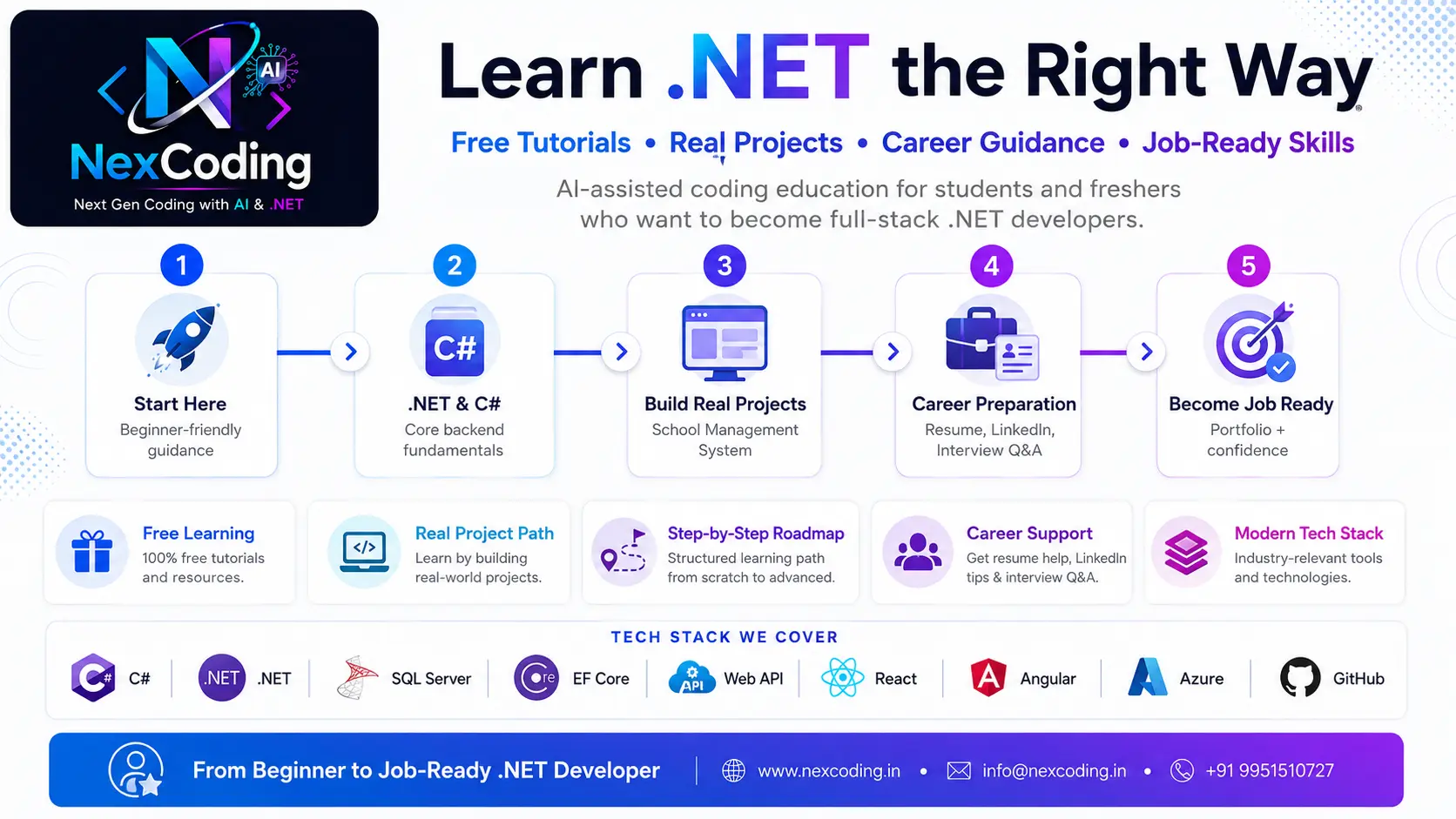
Every lesson is written by engineers who built real systems used by banks and insurance companies in India. These are practical lessons from working engineers.
Freshers preparing for jobs, students starting freelance work, career breaks restarting, and professionals switching stacks.
Answers to common questions from beginners like you.
Still have questions? Email us: info@nexcoding.in or WhatsApp: +91-9951510727
Join students learning .NET. 100+ articles. 12 real stages. Zero cost. Start from zero and finish with an online application you can show in interviews.